Precision data for national security
Understand the networks shaping the future of national security.
How does BlackGrove model the defense innovation ecosystem?
We begin by assembling billions of data points from procurement awards, patent filings, research publications, corporate registries, and other sources around the world.

Then we construct a knowledge graph of real-world entities
Suddenly you don’t just have raw data. You have a model of every entity and relationship shaping an innovation ecosystem.
9,302
Companies, institutes, and university labs developing hypersonic missile technology.
Last updated 2 days ago
4,916
Maps ground-test facilities, including shock tunnels, arc-heated wind tunnels, and scramjet combustion rigs, and links each facility to its operators.
Last updated 3 minutes ago
Suddenly you don’t just have raw data. You have a model of every entity and relationship shaping an innovation ecosystem.
Having a coherent map of open-source data means two things:
Insights grounded in evidence
National security decisions require intelligence that can be examined, challenged, and reproduced. We maintain provenance through our data pipeline so you can trace findings back to the raw data.
Continuous updates
BlackGrove’s model isn’t static. We incorporate new data and relationships into the knowledge graph, keeping it current as technologies, organizations, and the networks connecting them evolve.
Ask natural language questions
Which organizations are behind China’s CJ-1000 hypersonic missile?
China’s CJ-1000 program draws on 41 organizations spanning system integration, aerospace research, and testing. CASIC’s Third Academy leads system integration, while the Chinese Academy of Sciences’ Institute of Mechanics and China Aerodynamics Research and Development Center have broader connections across the program.
And see the reasoning behind every answer
Or pull structured data from our API
{
  "query": "CJ-1000 development network",
  "total": 41,
  "results": [
    {
      "id": "org:0f3a91c4",
      "name": "中国航天科工集团第三研究院",
      "name_en": "CASIC Third Academy",
      "type": "organization",
      "edges": ["development", "supply", "contract_award"],
      "sources": 14
    }
  ]
}
The output is always deterministic
BlackGrove applies graph-theoretic and statistical methods to examine a network’s structure over time.
Same question asked again…
Which organizations are behind China’s CJ-1000 hypersonic missile?
China’s CJ-1000 program draws on 41 organizations spanning system integration, aerospace research, and testing. CASIC’s Third Academy leads system integration, while the Chinese Academy of Sciences’ Institute of Mechanics and China Aerodynamics Research and Development Center have broader connections across the effort.
Six organizations connect otherwise separate groups; four are university laboratories, including Beihang’s National Laboratory for Computational Fluid Dynamics, Beihang’s State Key Laboratory of Aerodynamics, Nanjing University of Aeronautics and Astronautics, and Northwestern Polytechnical University.
Critical finding: recent activity at these laboratories points to a breakthrough in scramjet airframes: a forebody inlet/combustor design stabilizes supersonic combustion across changing flight conditions, potentially extending range by 15-25% with the same fuel capacity.
Sources: 4,208 procurement awards, 12,644 publications, and 3,917 patents on hypersonics. Last updated 13 September 2026.
Informs an intelligence assessment
BlackGrove illuminates the networks behind critical technologies
Platform
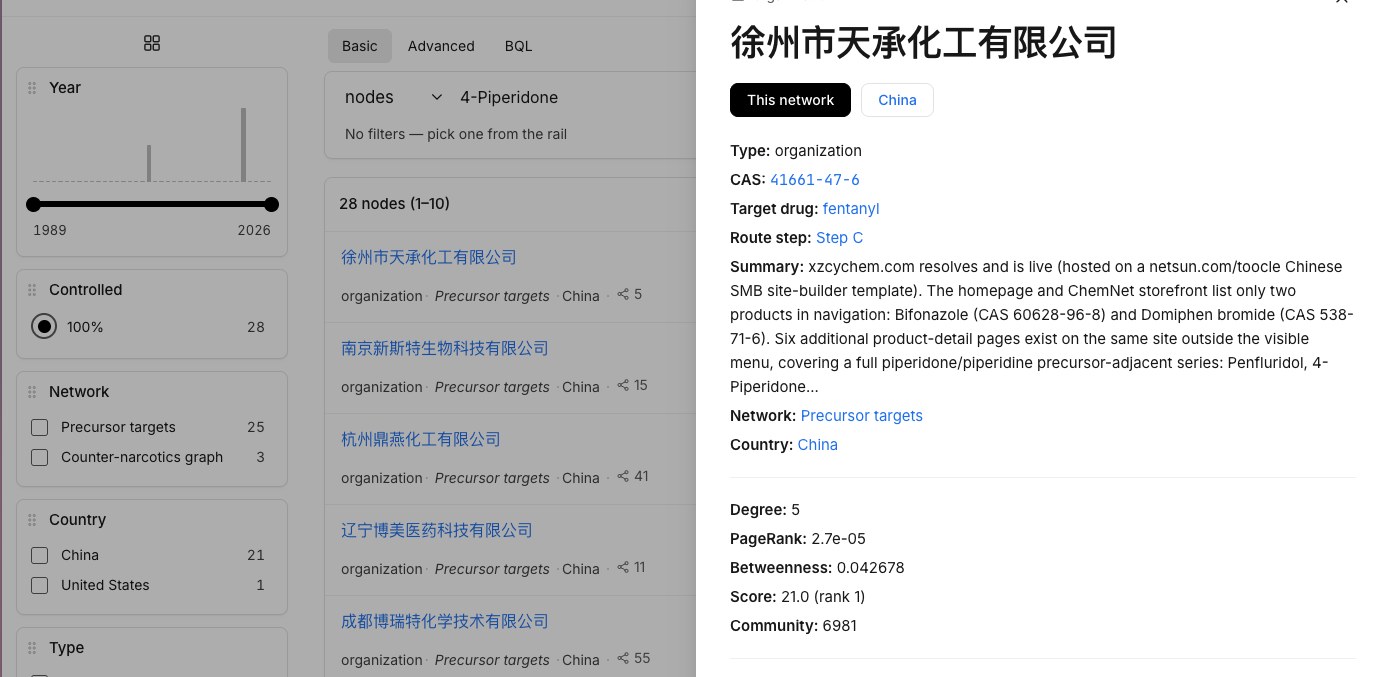
Explore our knowledge graph, investigate relationships, and find answers in minutes.
API
Pull our structured data into your systems efficiently and programmatically.
Reports
Get hand-written analytical reports from our team of subject matter experts.
To understand defense innovation, start with the right questions
- 01 What organizations are developing critical technologies?
- 02 Who is behind the emerging capabilities of foreign military programs?
- 03 How is expertise flowing across borders?